



05:55AM - 25.11.'15
|
News Source: autoblog.com |
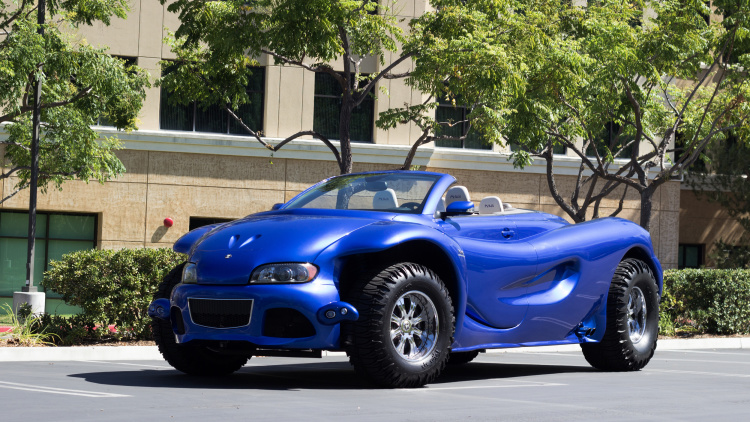
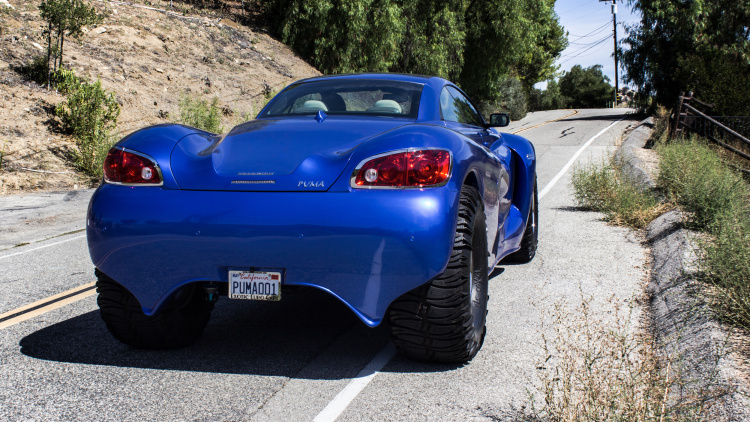
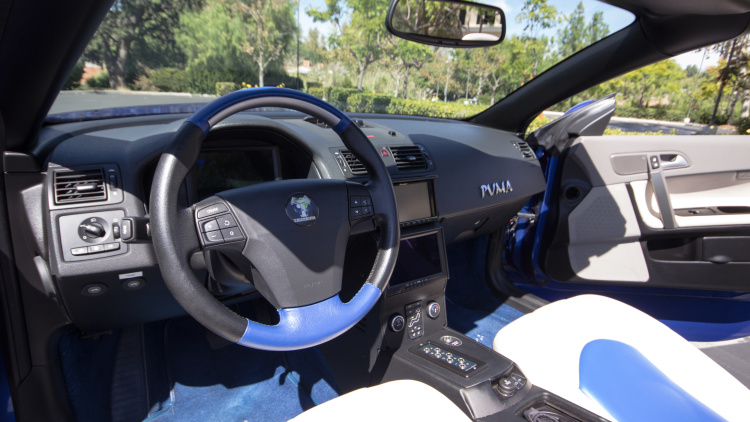
It was high noon, way up in the hills of Calabasas, California, and I was lost in a $1.1 million exotic car – but wasn't at the steering wheel. The vehicle in question was the plump, fishlike Youabian Puma that you see above. It was way too big for these roads. At 20 feet in length and 7.75 feet in width, it turned two-lane streets into single-width passageways. It didn't help that the roads in this area crisscross and follow the curvature of the mountains, making them difficult to navigate. Up here, it was impossible for the Puma to blend in, among the arid landscape and desiccated trees.Eventually, we found a road sloping downward, and headed toward it. Dr. Kambiz Youabian, who was at the wheel of the automobile bearing his name, asked a pretty obvious question. "How come it took you so long to contact me?" It's been two years since Youabian first pulled the XXXL cover off the Puma at a hallway booth at the Los Angeles Auto Show. ("I had to fight for that spot," he said. "They wanted to put me downstairs with all the aftermarket vendors.") The Puma's polarizing looks and larger-than-life size elicited responses from the media passing by, and not all of them were positive. Somehow, Youabian was unable to warm to comments critical of the Puma's styling, including "man, is it ugly," and began to issue cease-and-desist notices to some publishers (Autoblog included). Many brushed off the lawyers' memoranda, but they caused enough of a shock that coverage of the Puma, good and bad, ended almost right after the model's debut. To put it lightly, it was in our best interest to wait before meeting our hero. Once people told me they were tired of sports cars, that's when I changed this to a 'monster truck' car."For Youabian, the Puma is the culmination of a dream. "Since I was young, I wanted to design my own car and build something," Youabian said. "I always liked the sound of [Puma]. I wanted a name that was easy to say and catchy. I also like the animal. They're very exotic. They have a look to them that makes you fear them. With this car, I wanted it to feel like you own the road." What you don't know about Youabian is that, when he is not designing cars, he works as a physician and medical equipment salesman. "I'm a doctor, but I've always been very hands-on," he said. "I like art, I like drawing things and designing them." The Puma was a concept that he devised and wanted to bring to fruition. "I drew this design on a piece of paper, and then had someone put it into 3D software," he said. "I consulted chassis designers, builders, and fabricators. Then the car was built from the ground up." "I had designed this originally as a sports car," Youabian said. "Once people told me they were tired of sports cars, that's when I changed this to a 'monster truck' car." When he does drive his Puma among real people, say, in traffic on a California freeway, Youabian has his share of confused admirers. "Everyone starts taking pictures and driving," he said. "I worry that they're going to start having accidents." "Everybody's usually very nice," he said. "They have very nice feedback. They say, 'Great car!' A lot of them use profanity." He's heard a lot less in the way of negative feedback recently, so it seemed. From vehicle genesis to series production, there were some hiccups. Listening to Youabian explain the hurdles, from unexpected costs to matters of publicity, it became easier to understand the Puma's slow-selling fate. "Everything is hand-built – a lot of man hours," he said. "When I first started the project, I didn't think it would take so long to build. That's why, unfortunately, I've had to price it so high. I was hoping to price it lower, where it would be more affordable. Because it's so time-consuming to hand-build them, I've had to make it very expensive. ... I would have loved to open a dealership, but I haven't been able to sell as many cars to be able to do that." Production of the Puma is local, in Los Angeles. The auto show introduction in Los Angeles generated enough hype that Youabian built three additional Pumas for customers in China, Japan, and the Middle East. Its near-$1 million price made the Puma inaccessible to most potential customers, although Youabian said that out-the-door prices have ranged from $750,000 to 900,000. But still, two years after the Puma's introduction, Youabian has only sold three cars (the fourth, the show car and one you see here, is for sale). Those who did buy a Puma now own a rather extraordinary and rare vehicle. Its headlights come from a Volvo C70. Its taillights are from a Buick Enclave. Its engine is a 505-horsepower General Motors LS7 V8, the same one used in the last-generation Chevrolet Corvette Z06. (Youabian originally wanted to use the V10 from a Dodge Viper.) The Puma's transmission is related to the one found in the Cadillac Escalade. It's rear-wheel drive, although Youabian said that it can be configured as a true 4x4. And it's a hardtop convertible. "At the time when I started this project, the Volvo C70 was the only hardtop four-seater convertible," he said. "It took me so long to get this car finished that, by then, there were plenty of other four-seater hardtop convertibles out there," but the C70 remains the donor car for the interior compartment. To make up for the added space of the folding hardtop, also sourced from the C70, Youabian installed a secondary trunk behind the space where the roof folds. |