








|
News Source: topspeed.com
|
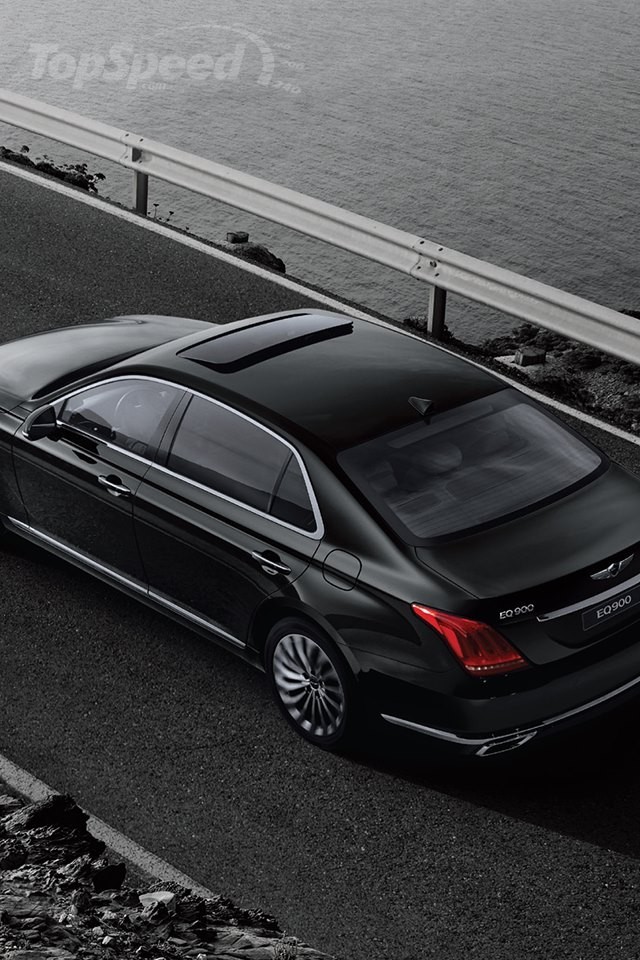
Labeled as an automaker that produces cheap cars for many decades, Hyundai has improved its brand reputation tremendously in recent years — thanks to automobiles such as the Genesis and the Equus. In 2015, after some six years of testing the premium segment with the aforementioned sedans, the Korean company has finally decided to enter the luxury segment with a dedicated brand. The said brand will go by the name Genesis and will include both the Genesis and the Equus nameplates, albeit under a new alphanumeric naming structure that will include the letter "G." The new division will be aimed toward similar products from Toyota’ s Lexus and Nissan’ s Infiniti arms. The first automobile to be launched under the new brand will be named the Genesis G90 in North America and the Genesis EQ900 in South Korea. Described as the brand’s new flagship model, the G90 just broke cover in South Korea, only a month after Hyundai announced the founding of the Genesis division. “Genesis’ new large luxury sedan G90 will deliver a concept of ‘New Luxury’ to our customers. The G90 sits at the pinnacle of the Genesis brand and demonstrates how we apply our human-centered values to give our customers true satisfaction in every aspect of the vehicle ownership experience,” said Woong-Chul Yang, Head of Hyundai Motor R&D Center. Although Hyundai had nothing to say about the U.S.-spec G90 model, the Korean EQ900 provides plenty of hints as to what we may get on this side of the Pacific. Let’s have a closer look at it in the review below. Updated 12/10/2015: After dropping the official details and images, Genesis also revealed a first video for its latest G90. Check it out to see how the G90 was completed with innovative design and perfect proportion. Styling-wise, the Genesis G90 introduces a new design language called "Athletic Elegance." The sedan was penned by the newly-founded Prestige Design Division, which promises to expand the design to the five new Genesis-branded models scheduled to arrive by the end of the decade. Fancy PR talk aside, the G90 is indeed an elegant and athletic sedan. Significantly more elegant than the large, but rather dull-looking Equus, the G90 is also very sporty for a vehicle of its size. The front fascia received a crisper version of the Genesis ’ massive grille and similar daytime running lights, but everything else was reshaped to give the sedan an exquisite appearance. There are LED headlamps that extend into the fenders, an imposing chrome insert into the muscular bumper There are LED headlamps that extend into the fenders, an imposing chrome insert into the muscular bumper, and a wing-type badge above the grille. The long hood seems to retain the Genesis’ clean lines. The car’s profile is unlike anything else Hyundai has designed to date. The G90 has a tall shoulder line, muscular rear haunches, large wheels, and a large glass area for the rear doors. The steeply raked rear windscreen, short rear deck, and the vertical taillights that extend into the fenders give it a unique look in the luxury segment. Although it feels as massive as a Bentley Flying Spur, the G90 is incredibly sporty and elegant for a Hyundai. As far as dimensions go, the G90 is 1.7 inches longer and 0.6 inch wider than the Equus. While the new sedan is not significantly larger than its predecessor, its wheelbase is no fewer than 4.5 inches longer, which speaks volumes of Hyundai’s efforts to improve comfort and roominess. Much like the exterior, the interior is also a significant departure from the Equus. Although the latter was pretty luxurious for a Hyundai , it was no match for most of its competitors in terms of soft-touch materials, craftsmanship, fit and finish. The G90 appears to have fixed that with a redesigned cabin that features human-centered ergonomics, improved materials, and an elegant color palette. The new design brings together Italian and Nappa leather, rear wood trim, contrast stitching, and polished aluminum inserts. The cabin also feels a lot more modern compared to the Equus, which looked dated even when compared to the previous-generation S-Class. The new design brings together Italian and Nappa leather, rear wood trim, contrast stitching, and polished aluminum inserts. The latter are spread throughout the dashboard, center console, and upper door panels. Overall, the cabin looks like a plush and fancy place to spend time, and if it weren’t for the Genesis badge on the steering wheel, you wouldn’t know you’re sitting in a Korean car. The newly-developed seats are certified by German back specialists and come with 22-way power adjustment for the driver and 14-way setting for the passengers. The vehicle is also equipped with a Smart Posture Caring system that positions the seat, steering wheel, head-up display, and side mirrors to the driver’s optimal position. High-end tech includes a 12.3-inch touchscreen (as large as Mercedes’ unit), a new parking camera, and 360-degree monitor among many other features. A Lexicon surround sound system promises to provide a hi-fidelity listening experience. This is also possible due to extensive efforts Hyundai has made toward reducing NVH (noise, vibration and harshness) levels, by using special sound-absorbing materials, laminated glass for each window, and an optimized suspension setup for high-speed cruising with minimum body vibration. The automaker claims that the G90 boasts best-in-class ratings for in-cabin quietness, but we won’t find if this is true or not until the sedan is tested against its main competitors. Motivation of the G90 comes from three of Hyundai’s current engines. The base drivetrain is a naturally aspirated 3.8-liter V-6 rated at 315 PS (311 horsepower). The unit is similar to the one offered with the Equus in Asia, but it delivers an extra 25 PS (25 horses). Next in line is the turbocharged, 3.3-liter V-6 with 370 PS (365 horsepower) on tap. This unit, also used in the Azera, Genesis, and Santa Fe, replaces the Equus’ 4.6-liter V-8, which delivered either 361 or 378 horses. Finally, the G90 also received the 5.0-liter V-8 available with both the Equus and the Genesis. In the G90, it generates 425 PS (419 horsepower), a 10-PS (10-horsepower) reduction compared to the Equus . With this powerplant, the sedan will be able to hit 62 mph from a standing start in as little as 5.7 seconds. Although this is pretty impressive for a Hyundai of this size, the G90 is significantly slower than the Mercedes-Benz S550, which needs only 4.8 seconds to hit the same benchmark. There’s no official word as to what engines will become available in the U.S., but the 5.0-liter V-8 and an eight-speed automatic transmission are a safe bet. A hybrid drivetrain should also be on the table, but it will probably be offered later in the sedan’s life cycle. Hyundai brags about the Genesis G90 featuring "several world-best safety technologies" and the strongest body frame in the full-size class. Details are scant at this point, but the Koreans did list Autonomous Emergency Braking with Pedestrian Detection, Active Blind Spot Detection, Driver Attention Alert, Smart High Beam Assist, and an Around View Monitor among the sedan’s safety features. Pricing is obviously not yet available at this point, but given that the Equus retails from $61,500, the Genesis G90 could fetch more than that. Expect the U.S.-spec model to break cover at the 2016 Detroit Auto Show in January and arrive in dealerships by the end of the year. |

|



| Copyright © 2026 • www.showcar.com.au • Showcar Pty. Ltd. • Contact info@showcar.com.au | sydney web design & development by Webski |