








|
News Source: topspeed.com
|
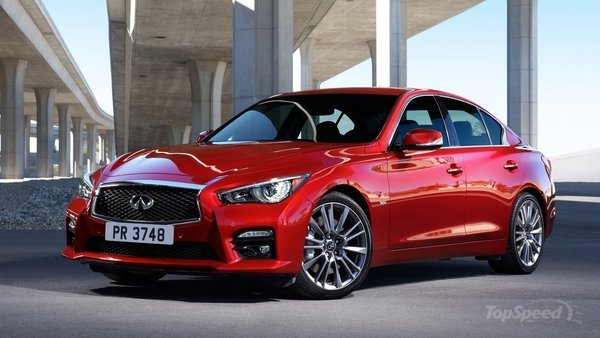
The Infiniti Q50 is a relatively fresh face in the world of compact luxury sedans, evolving from the G-Series model line as recently as 2013. But while the nameplate might be new, it still brings that time-tested combination of snappy good looks, high-tech features, and healthy performance potential – exactly what you’d expect from a prime segment contender. Consequently, the Q50 is currently Infiniti’s best-selling model in North America, with sales numbers growing impressively over the past year. To keep that momentum rolling into 2016, the Q50 receives a slew of enhancements under the skin, including updated infotainment, revised suspension technology, and a few very impressive new engine options. The biggest attention-grabber is undoubtedly the 400-horsepower twin-turbo V-6 that takes top honors on the trim level totem pole. While far removed from the 560-horsepower, GT-R- derived, M3- eating Q50 Eau Rouge concept we were all hoping for, rest assured the new range-topping Q50 is still no slouch. The tail is rounded and wide, finishing the profile with a moderately raked stance. For the 2016 update, Infiniti was content to leave the Q50’s exterior essentially unchanged. The easily recognizable Infiniti front fascia is retained, including a distinctive 3D mesh double-arch grille. Taut creases along the hood add a sense of muscle-bound poise, drawing back into the roofline, shoulder line, bottom door line, and rear bumper. Chrome is used for the side window surrounds, door handles, and trunk, echoing the front grille for a top-shelf appearance. The tail is rounded and wide, finishing the profile with a moderately raked stance. Finally, LEDs are utilized for the headlights and daytime running lights. In order to make the top-of-the-line, 400-horsepower Q50 (aka the Q50 Red Sport 400) stand out amongst its lesser brethren, Infiniti added unique exhaust tips and exclusive 19-inch aluminum wheels wrapped in summer performance run flat tires. The tires are staggered at 245/40 in the front, and 265/35 in the rear. No word yet on whether this most-powerful-of-the-bunch Q50 will only be offered in red, but it definitely sounds like it. Hey, at least it kinda looks like the Eau Rouge, right? Right?! The cabin design is also carried over from the previous model year. Gently curving lines and premium materials are used throughout. The central tunnel is once again split corner-to-corner, with the top half occupied by the shifter and driving controls, and the bottom occupied by twin cup holders. The steering wheel comes with three spokes and dual multi-function pads, as well as an optional heating function The steering wheel comes with three spokes and dual multi-function pads, as well as an optional heating function, and paddle shifters made from magnesium. The front seats are also available with a heating function. Dual touchscreens are found on the center console, with an 8-inch unit mounted above, and a 7-inch unit mounted below. Infotainment options include the latest Infiniti navigation system, SiriusXM traffic, and voice recognition. All told, you won’t be left wanting when it comes to interior features, just so long as you choose the appropriate package options. The drivetrain is where you’ll find the real meat of the update. The old naturally aspirated 3.7-liter V-6 (aka the VQ) is no more, but that’s to be expected – after more than 20 years and a huge list of applications, the VQ is getting more than a little long in the tooth, even if it is a superb six-cylinder. In its stead, you’ll find four engines to choose from. Let’s start at the top. New for 2016 is an in-house developed 3.0-liter V-6 equipped with two turbochargers and direct injection. New for 2016 is an in-house developed 3.0-liter V-6 equipped with two turbochargers and direct injection. It’s called the VR30, and it’s offered in two states of tune. The most powerful option puts out 400 horsepower at 6,400 rpm, and 350 pound-feet of torque between 1,600 rpm and 5,200 rpm. Below that is a detuned option with 300 horsepower at 6,400 rpm and 295 pound-feet of torque between 1,600 rpm and 5,200 rpm. The VR30 uses a new turbine speed sensor and optimized turbine blade design to sharpen throttle response and dish out additional ponies, with turbine speeds upped to a dizzying 220,000 rpm. Additionally, valve timing gains a new electric motor for even more response. While touting a fat torque curve, the VR also boasts higher fuel economy. Infiniti claims the VR is the cleanest, most efficient V-6 it’s ever made, and while exact numbers are still forthcoming, the automaker did mention an increase of up to 6.7 percent. Between the two VR powerplants is a hybrid drivetrain, which carries over to 2016 unchanged. Making the bang is a 3.5-liter, 24-valve, DOHC aluminum V-6, which on its own produces 302 horsepower and 258 pound-feet of torque. Electrification is provided by a 50-kW electric motor and lithium-ion battery, which produce 67 horsepower and 214 pound-feet of torque. Net horsepower is a healthy 360. Infiniti says the hybrid’s priority is performance, but decent fuel economy is still possible. Finally, there’s a new base engine for the Q50 – a turbocharged 2.0-liter four-cylinder that produces 208 horsepower at 5,500 rpm and 258 pound-feet of torque at only 1,500 rpm. If those figures sound familiar, it’s because it’s the same engine found in the Mercedes -Benz CLA. The block, head, and crankcase are made from aluminum, cutting weight, while direct injection, multi-spark ignition, and a variable camshaft design on the intake side all contribute to greater fuel efficiency. The 2.0-liter also offers an idle start-stop system – a first for the Q50. Each of the four engines mates to a seven-speed automatic transmission, which includes electronically controlled “manual” shifting, adaptive shift control, and multiple drive modes. Buyers get RWD as standard, but AWD is available for each model. Infiniti went to great lengths to improve the Q50’s steering, offering up its next-generation Direct Adaptive Steering (DAS) system as an available option on models equipped with either the twin-turbo 3.0-liter, or hybrid drivetrain. DAS is a digital steering system that comes with a variety of customization options Essentially, DAS is a digital steering system that comes with a variety of customization options, including a setting that feels more like a conventional steering system. Steering assistance, feedback, and steering ratio are all adjustable, offering light feel in slow-moving traffic, and less assistance at high speeds. It’s also faster than a mechanical system, capable of 1,000 steering adjustments per second. DAS will intelligently select appropriate feedback to send to the driver, which gives a clearer idea of the road surface and chassis behavior, while simultaneously reducing driver fatigue. DAS also offers more steering modes, and now includes Personal (aka customizable), Standard (default), Snow, Eco, Sport, and the new Sport+. These are all pretty self-explanatory, but it does bear mentioning that Sport+ essentially does all the things Sport does (faster ratio, more feel), but more (hence the name). Standard equipment on models equipped with the twin-turbo 3.0-liter and hybrid drivetrain is an electronic power steering rack, which was updated to offer a more linear feel, and includes multiple customizable driving modes. Finally, models equipped with the 2.0-liter four-cylinder get a standard speed-sensitive hydraulic rack-and-pinion steering system. Complementing the new steering is an updated Dynamic Digital Suspension (DDS) system. Various settings were tweaked to strike a new balance between prowess and comfort, while the stabilizer bars were revised for flatter cornering. Double-wishbones are still in front, and a multi-link is still in the rear. Copious aluminum was used to cut weight. As you can imagine, DDS is electronically adjustable and includes multiple driving modes, but it also self-adjusts while on the move to compensate for variable body pitch, roll, and bounce rate. |

|


| Copyright © 2026 • www.showcar.com.au • Showcar Pty. Ltd. • Contact info@showcar.com.au | sydney web design & development by Webski |