








|
News Source: topspeed.com
|
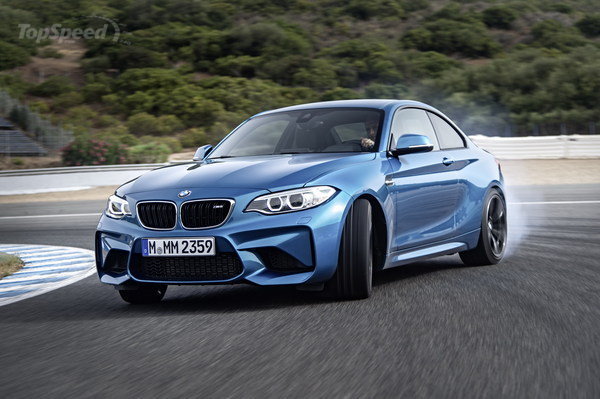
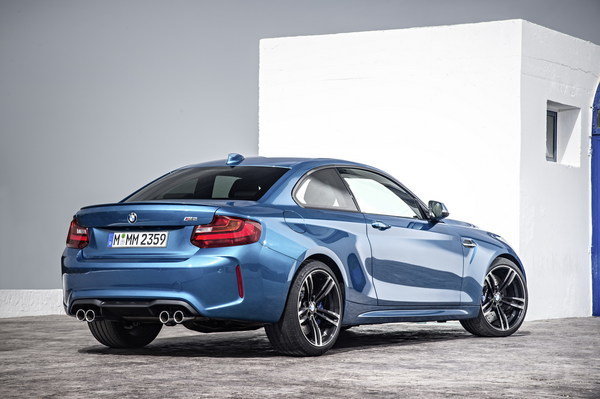
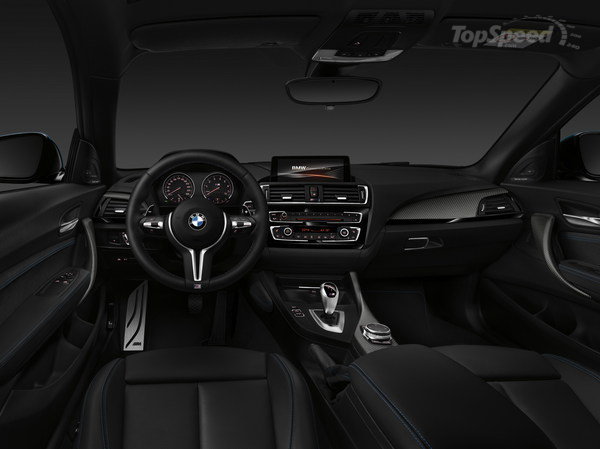
The BMW 1 Series M was an amazingly fun and agile car, but its limited two-year run from 2010 to 2012 resulted in the 1M being more of a unicorn than a track-slaying monster. BMW tried to bring some of the 1M’s charm back into dealerships with the M235i, but the performance-oriented coupe was too heavy and lacked the aggressiveness of its forerunner. Fortunately, the BMW M2 has finally arrived for the 2016 model year, bringing a similar combination of high power and lightness as its predecessor, while being produced in larger numbers for more track enthusiasts to enjoy. Essentially an M235i on steroids, the M2 promises to be a true driver’s car. Although the 2 Series was only launched in 2014 as a successor to the 1 Series Coupe, BMW links the M2’s heritage to iconic Bimmers such as the original E30 M3 and the 2002 Turbo of 1973. It may seem a bit out of place to link the M2 to the E30 M3 with the M4 around, but the littlest M offering yet seems to have what it takes to be considered a worthy successor of the legendary mid-1980s coupe. Keep reading to find out why. Updated 12/29/2015: The guys over "ringzwei" created a very cool promo video for the new BMW M2. Hit "play" to watch the new M2 in action on a wet track. Visually, the M2 follows in the footsteps of the M4, featuring significantly more aggressive styling cues front and rear compared to the M235i. Many details, including the bumpers, are based on those seen on the M3, M4, and M6 – a sign that BMW wants the M2 to be treated as a full-fledged M car – a status the coupe fully deserves. The M2 follows in the footsteps of the M4, featuring significantly more aggressive styling cues front and rear compared to the M235i Up front, everything except the bumper and the M badge on the twin-kidney grille is identical to the M235i. However, the revised bumper is enough to turn this car into a menacing coupe thanks to its massive air intakes, honeycomb grille, and sculpted aero add-ons. Though it’s not as sleek as the M4’s, the front fascia exudes sportiness through every pore and turns the M2 into a modern-day "Flying Brick." For the uninitiated, the "Flying Brick" was a nickname attributed to the heavily modified E21 3 Series coupe BMW prepared for Group 5 racing in the 1970s. Not just because of its boxy design, but because it was damn fast and looked as if it could destroy anything in its path. The M-specific upgrades continue around back, where the coupe gained a beefed-up bumper with with deeply sculpted horizontal lines that highlight its firm grip on the road. Unlike both the M235i and the M4, the M2’s bumper features vertical reflectors at the outer extremes, which mirror the trapezoidal design of the front apron. The rear bumper is finished off with a sporty diffuser that incorporates BMW M’s trademark quad-exhaust pipe arrangement. The M2 looks like a proper M car from the sides as well The M2 looks like a proper M car from the sides as well. The beefier front and rear bumpers make the coupe 2.1 and 3.1 inches wider, respectively, while the lowered suspension brings the two-door closer to the ground. The package is rounded off by a set of 19-inch aluminum forged rims in BMW M’s familiar double-spoke design. Customers can pick between four exterior colors: Long Beach Blue Metallic, Alpine White, Black Sapphire Metallic, and Mineral Grey Metallic. Granted, most of these colors aren’t exactly inspiring, but it’s a minor issue given everything else the M2’s design has to offer. As far as dimensions go, the M2 is 176.2 inches long and 73 inches wide. This makes it seven inches shorter than the M4, but less than an inch narrower than its bigger brother, which explains its more muscular stance. Also, the M2 is about the same size as the original E30 M3, which should please enthusiasts that have been complaining about the M4 growing too big in recent years. As with all BMW M models, the interior of the M2 is driver-oriented and packed with M-specific features. The standard seats have been replaced with M-badged sport units with adjustable side bolsters for optimum support on the race track. They come wrapped in black Dakota leather with blue contrast stitching, as does the steering wheel. Naturally, the dashboard’s design is identical to the rest of the 2 Series lineup, but enhanced by means of carbon-fiber inserts above the glove compartment and around the driver side A/C vents. The center console also has a large chunk of carbon-fiber, as well as blue stitching on the knee pad, and an M-spec gear shifter. The interior of the M2 is driver-oriented and packed with M-specific features The instrument cluster uses M2-specific dials and needles. A speedometer scale reaching 200 mph and a tachometer reading up to 8,000 rpm provide an indication of the car’s performance potential as soon as you climb aboard. Other highlights include M logos on the tachometer and door sill plates; an M steering wheel with shift paddles; and Alcantara on the door panel inserts, parking brake boot, and shift lever boot. Tech-wise, the M2 comes with the cool GoPro app and the M Laptimer app. The GoPro app, which can be operated using the iDrive touch controller, allows drivers to film their laps at the race track. The footage will be displayed on the car’s Control Display. The M Laptimer records the car’s speed, longitudinal and lateral acceleration, engine’s speed, the gear engaged at any time, the steering angle, the accelerator position and fuel consumption, providing drivers with all the necessary info to improve their laps. The heart of any BMW M car is the performance and handling, and the M2 will certainly deliver. Power comes from a 3.0-liter inline-six using BMW’s Twin-Scroll turbo technology, high-precision direct injection, Valvetronic, and pistons and crank bearings borrowed from the M4. The unit cranks out 365 horsepower at 6,500 rpm and 343 pound-feet of torque available from as low as 1,400 rpm, a 45-horsepower and 13-pound-feet improvement over the M235i. Power comes from a 3.0-liter inline-six using BMW's Twin-Scroll turbo technology The engine mates to either a standard six-speed manual or an optional dual-clutch automatic. Both versions will be equipped with BMW’s Active M differential that optimizes traction and enhances stability. The electronically controlled multiplate unit will keep the wheel spin in check, preventing the M2 from going off track on slippery road surfaces. The coupe rides on Michelin Pilot Sport tires, a wider track, and a lightweight, M Sport suspension. Stopping power comes from M compound brakes with 15-inch rotors and four-piston calipers up front and 14.5-inch rotors and two-piston units in the rear. Besides the extra oomph, the M2 also benefits from a lighter curb weight, though BMW’s effort in this department is far from spectacular. The M2 tips the scales at 3,450 pounds with the manual transmission and 3,505 pounds with the DCT, which accounts for an 85-pound reduction over the M235i and a 106-pound reduction over the M4. The M2 is no Lotus... Still, the coupe is impressively fast in a straight line, being able to hit 60 mph from a standing start in 4.2 seconds with the automatic and 4.4 seconds with the manual. These figures make it more than a half-second quicker than the M235i and just 0.3 second slower than the M4. Not bad! BMW claims the M2 can lap the Nurburgring Nordschleife in 7:58 minutes |

|

| Copyright © 2026 • www.showcar.com.au • Showcar Pty. Ltd. • Contact info@showcar.com.au | sydney web design & development by Webski |