








|
News Source: topspeed.com
|
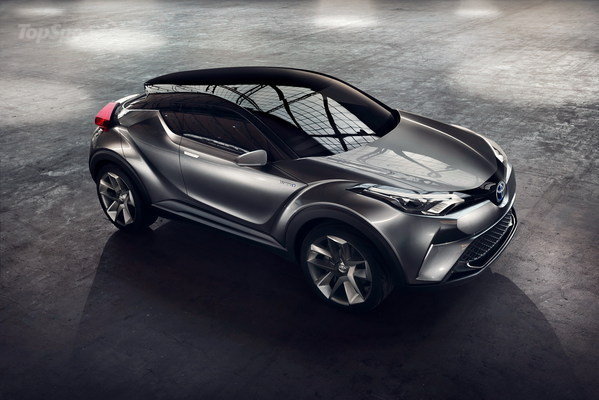
Toyota participated in the 24 Hours of Nürburgring from 2007 to 2014 under the nomenclature of GAZOO racing. Then, in April of 2015, Toyota GAZOO racing was conceived as a way to unite the activities of GAZOO Racing, Toyota Racing and Lexus Racing. The goal was to put all three under the same roof, with a focus on creating better car and bringing in an increasingly wider range of enthusiasts. Now, as we work our way through the first month of 2016, Toyota has released some rather interesting news. Just today, it has been announced that Toyota GAZOO racing has entered the Lexus RC and Lexus RC F into the 24 Hours of Nürburgring for 2016. That’s not the most interesting part, though. Remember the 2014 Toyota C-HR Concept from 2014 Paris Motor Show? Or, how about the second iteration of it that debuted at the 2015 Frankfurt Auto Show? Well that concept, in what will be the closest form of a production version we’ve seen so far, will debut at the 24 Hours of Nürburgring this year as the Toyota C-HR Racing. In all reality, that is pretty wild news. Since the first concept debuted back in 2014, certain aspects of it – primarily the drivetrain – has been kept a closely guarded secret. In 2015, the concept was shown with a design that was closer to being ready for production, but we were still left wondering just want was hidden under the hood. With the press release that flew off the printer today, Toyota included a rendering of the Toyota C-HR Racing, but the real details are still filed away in Toyota’s room of classified information. At least now we’re getting to see what the drivable variant of the C-HR will probably look like, even if it is designed solely for the race track. I really wish we knew just what the “full-hybrid powertrain” under the hood was all about, but until Toyota decides we’re worthy of that information, we can at least speculate. That said, let’s take a gander at the C-HR, what we see in the newly released image, and make a few predictions while we’re at it. Note: 2016 Toyota C-HR Concept II pictured here. When the C-HR first Debuted back in 2014, it introduced a totally new, but bold design language. And, as you can see, that design language is still very much a part of the rendering of the C-HR racing. Designed as a compact crossover that would be slated to compete against the likes of the Nissan Juke , the C-HR had to have such a radical design. We thought we would see a production version before a racing version, but sometimes Toyota likes to throw us a curve ball. In comparison to the 2016 C-HR Concept, the C-HR Racing is very similar. In comparison to the 2016 C-HR Concept, the C-HR Racing is very similar. Up front, the huge air dam still sits at the bottom of the fascia on top of a rather thin spoiler that should provide at least a little downforce. In the concept version the corners of the fascia hard sharp cutouts for fog lights, but in this rendering, it looks like the fog lights have been left out to make war for air vents. Surrounding the big Toyota emblem and extending under the headlights a small opening provides air flow. This design either indicates a very low sitting radiator, a really small cooling system, or a lack of a radiator all together. The hood carries a similar design, but the sides aren’t raised as much, nor are they as sharp as what we saw on the concept. The rear isn’t visible in the rendering, but it looks like those protrusive taillights remain a part of the C-HR Racing’s rear design. Moving to the sides, the wheel arches are still very well pronounced, giving the C-HR Racing a wide-looking stance. Those arches aren’t quite as dominating in the front, but as we move closer to the rear, the body is almost identical. Even those extreme side skirts remain and were probably designed with aerodynamics in mind from the beginning. The rear, side windows are still virtually nonexistent, with the rear corners coming to a sharp upward point. The rear isn’t visible in the rendering, but it looks like those protrusive taillights remain a part of the C-HR Racing’s rear design. That massive bench-looking spoiler is either mounted to the inner edge of the taillights or on what would be the rear deck/hatch – assuming the C-HR ever had a rear opening back there to begin with. We do know the styling of the rear end on the 2016 concept was extreme, so expect it to be toned down a bit for the racing version to accommodate for better aerodynamics. I kind of expect the rear end to be smoother on the racing version, something similar to the Chrysler Spitfire from the mid-2000s. Expect a roll cage to outline the interior, and that infotainment screen will likely provide most of the important information to the driver. At this point, the interior of the C-HR is one of those classified secrets. We do have a little to go off of, however. Back with the first concept was announced, Toyota did provide an image of the interior that resembled something similar to the Nissan Juke. By that I mean the center console was pushed forward, probably leaving floor space between the front seats. The center stage was relatively simple with a digital display in the middle that would likely control the HVAC system, and what appeared to be a six- or 6.5-inch infotainment screen. The steering was somewhat oval shaped with thumb controls on the side spokes. The Instrument cluster was also small, with a massive gauge protruding from the middle. This description is probably similar to what we’ll see with the C-HR Racing, but it will obviously be prepped for the track instead. Expect a roll cage to outline the interior, and that infotainment screen will likely provide most of the important information to the driver. Otherwise, the steering wheel should have a different design to accommodate the C-HR’s racing nature. The rest of the interior will probably be absent, as weight control for C-HR Racing will be an important factor to its performance. Expect all of the common racing equipment normally found in race cars of this nature. |

|



| Copyright © 2026 • www.showcar.com.au • Showcar Pty. Ltd. • Contact info@showcar.com.au | sydney web design & development by Webski |